DCPA NEWS CENTER
Enjoy the best stories and perspectives from the theatre world today.

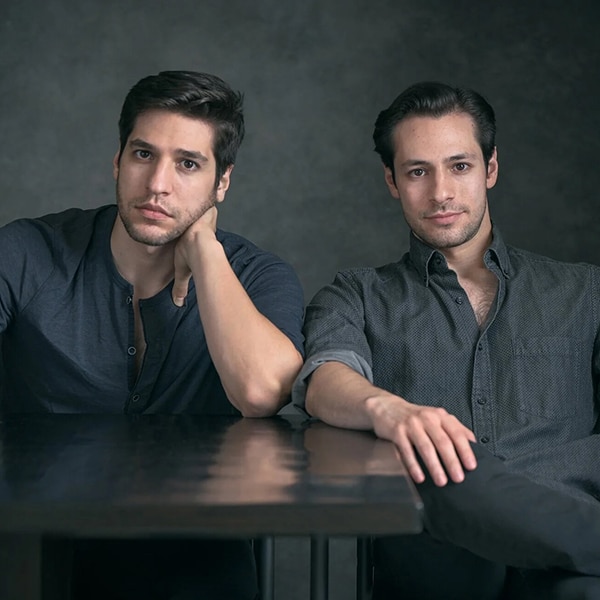
Jeff and Rick Kupperman
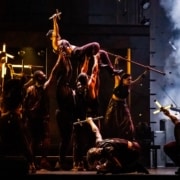
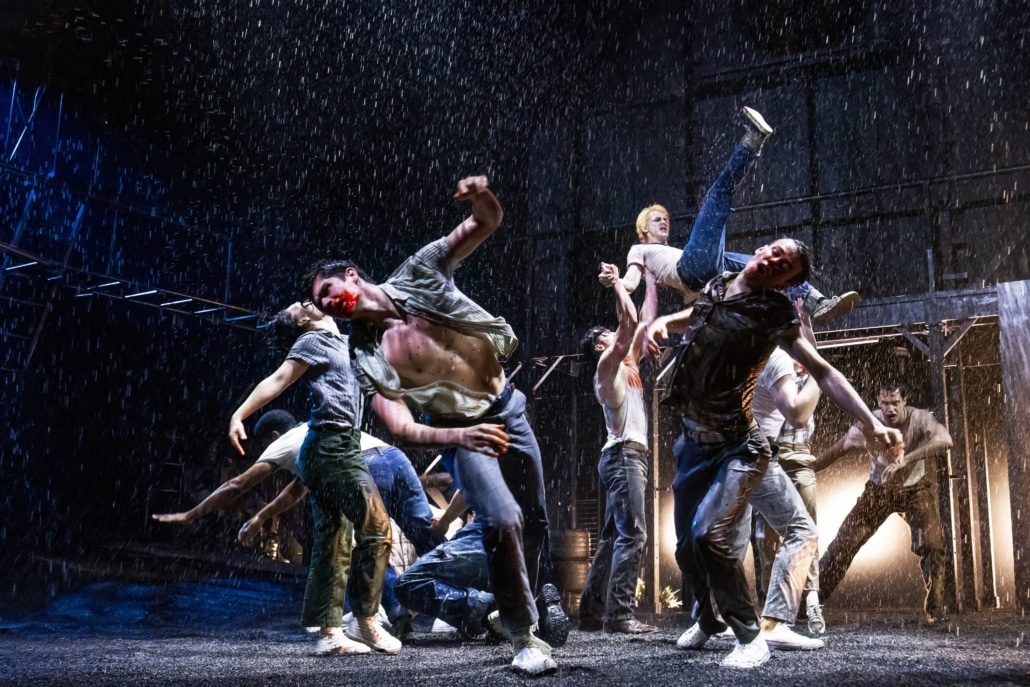
JEFF: One of the first things we do is read the script and listen to the music, and we do that a few times until it is bouncing around our head. Then we’ll create our own documents of free association for certain musical numbers. At that point, we come together and identify the number for which we have the clearest vision, and we’ll start there. We’ll really investigate that one piece in a studio together to start to develop the movement language for the show. Once we have a sense of that vocabulary, everything else comes together organically for us. For The Outsiders, that piece was the rumble. We were thinking about how to make the rumble as impactful as it is on the page. One of the first things we responded to was Adam Rapp’s stage direction about it being the brutal sound of “fists detonating into flesh.” That image — the ripple of violence — sparked an idea. So much of the way we interpret violence is aurally and if we could be faithful to that stage direction, then we’d be able to make a successful rumble.
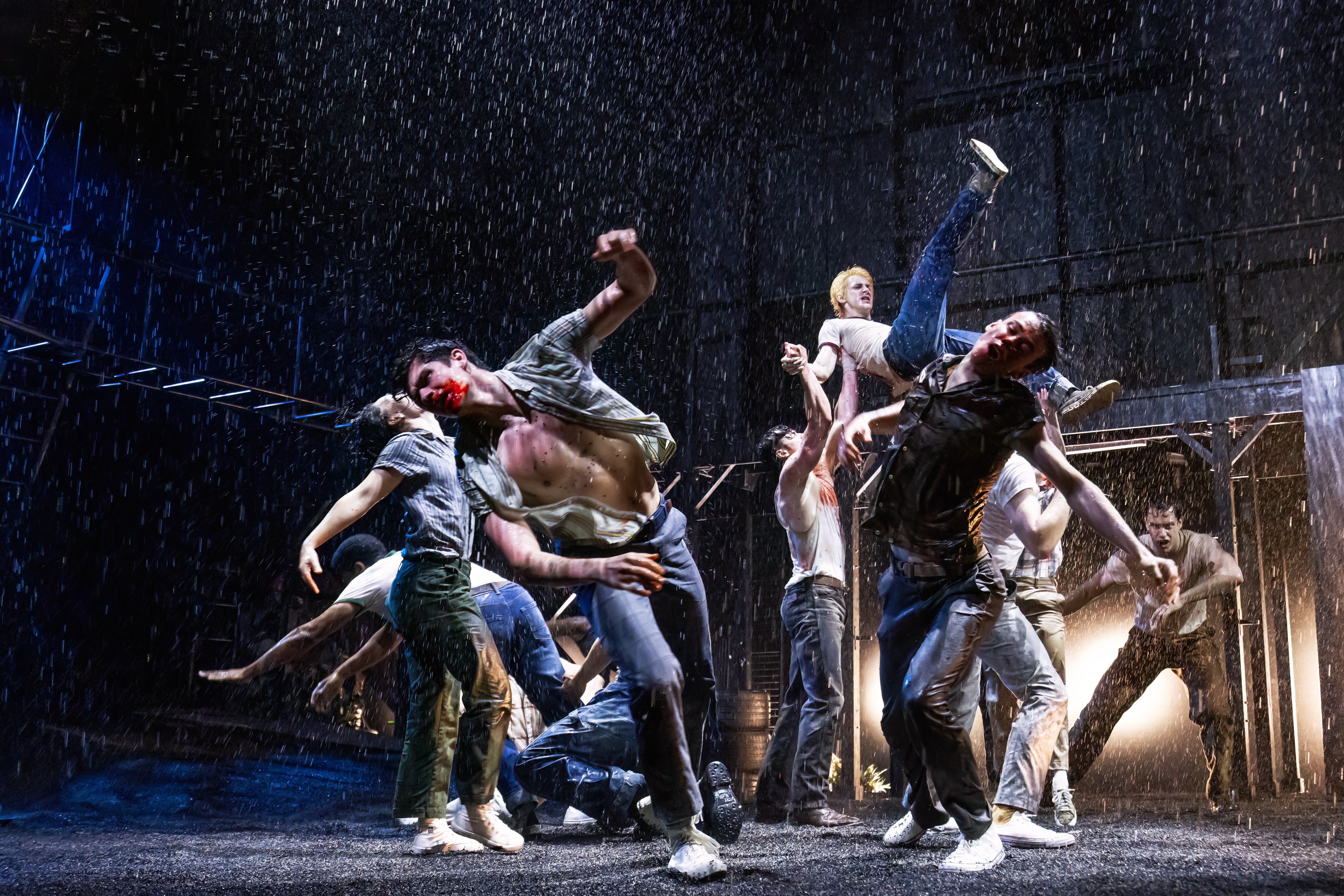
The Cast of The Outsiders. Photo by © 2024, Matthew Murphy
RICK: Storytelling through movement has a very long tradition, and there is a ton of opportunity to communicate nuance through physical movement. In The Outsiders, the choreography gives us access to Ponyboy’s memories. The linear nature of experiencing life moment to moment morphs as the mind encodes memories. Certain moments have a huge amount of real estate in our minds — the heightened moments, the important moments, the traumatic moments — so choreography helps give us that feeling of what Ponyboy’s memories might be like. In addition, choreography can transport us across time and space. For example, when Ponyboy and Johnny run away from home and hop on a train to hide from the police, there is a sense of anxiety, urgency, and travel. There is one way to express that in a novel, another way to express it on camera, and choreography is a helpful tool to give us that sense on stage.
JEFF: This is also true of the rumble. The rumble starts like a real fight, so we immediately get a sense of the stakes, but then it evolves into something more expressionistic. The movement vocabulary unlocks an even greater violence and an even greater ability to express the pain and the uselessness of the fight. The entire storytelling modality of this show incorporates movement. Sometimes it’s dance, like in the scene at the drive-in; sometimes it is character exploration like in “Grease Got a Hold.” And then there are moments where characters are entering and exiting, carrying planks, and transforming scenery; it’s not dance, but it is choreography, and it is movement. The way that this ensemble breathes together is another way you sense movement, but you don’t necessarily lock into it. It’s happening subconsciously. Movement is informing the way that you are absorbing the piece.
RICK: There is, to some degree, a bit of demarcation between how the Socs move and how the Greasers move. And, at the same time, they are all teenagers in Tulsa in 1967, so we didn’t want to lean too far into that cliché of red team/ blue team. So even though they have their own identities and their own way of moving, there is also an overall language of Tulsa, 1967 that keeps it unified.
JEFF: Warm up was a huge part of the process. Spending time together, warming up, seeing each other, and moving together in a way that didn’t have anything to do with the show, was certainly an extremely important part of the way that the company bonded together and found who their characters were within the context of the larger group. Danya led a lot of mirroring exercises so that people could understand their relationship to one another — from an angry Soc who might drink too much to a Greaser who had a tough background — and explore that relationship even though they might not say any words to each other in the entire show. They still have a relationship, and you can feel that in the work. We also did some Viewpoints* exercises so that we could sync up in terms of the speed and quality of our movement when we are moving through the show and changing place and time. We also included a bit of martial arts training to get those punches looking real and to teach how to harness and redirect force so that we didn’t have to fake force.
RICK: The goal of Viewpoints* and associated exercises is to help an ensemble move together, to develop a proprioception of individual members of an ensemble so that they have an awareness of where their other team members are at any given moment. It comes in handy, certainly in the rumble when we have that many bodies so close to one another on a limited stage space, but also, in terms of how the ensemble manipulates the cinder blocks and planks and other scenic elements that help us move from place to place.
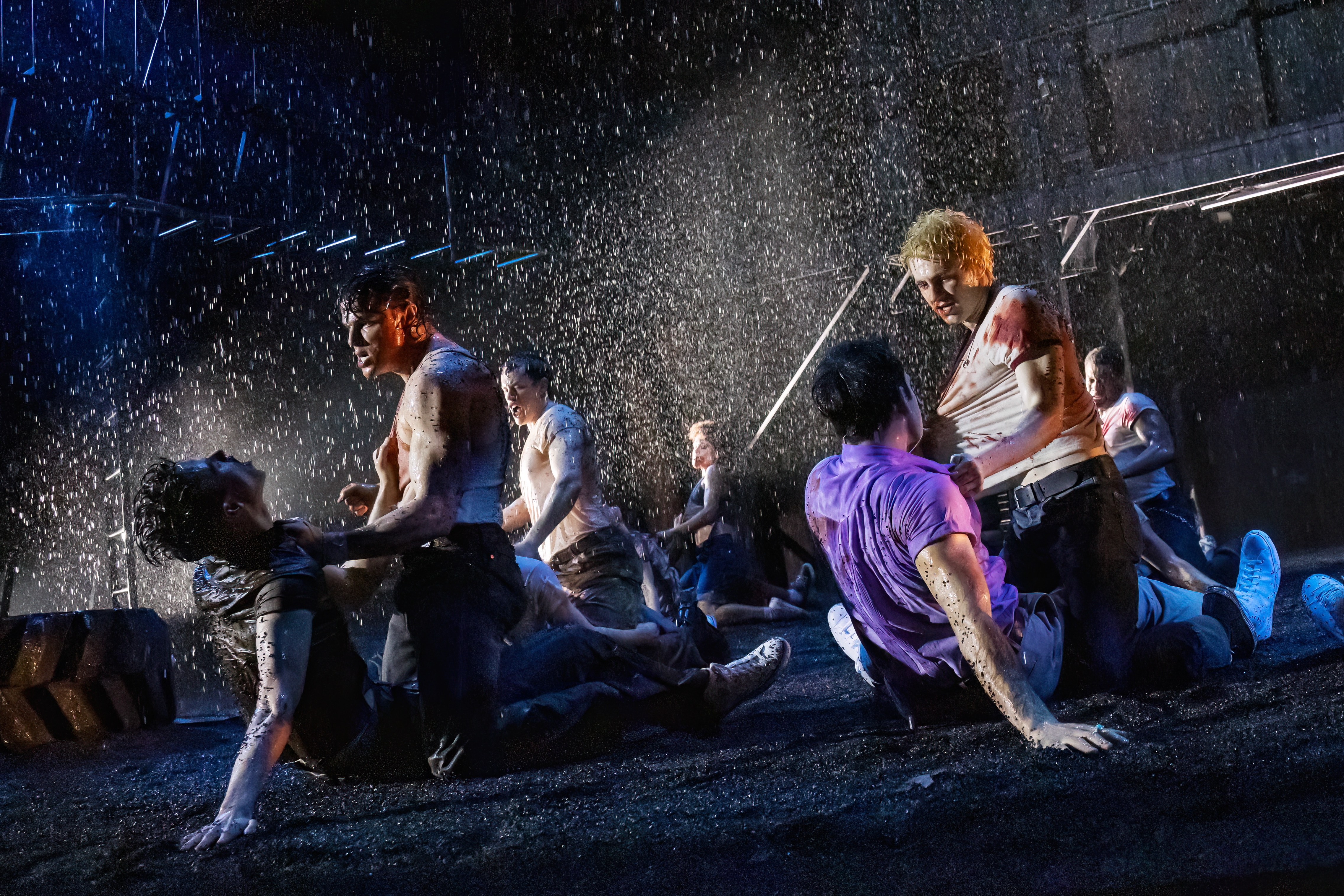
The Cast of The Outsiders. Photo: © 2024, Matthew Murphy
JEFF: One of the reasons why I love working on this show is because the entire creative team doesn’t necessarily feel siloed into their own disciplines. What I think makes a good choreographer is the ability to think not only about movement, but about how movement fits into the larger piece and how it can elevate the form as opposed to being a contained part of it. It’s important to learn about lighting, sound, acting, direction, and music — all of it — so that you can be an equal collaborator.
RICK: Another piece of advice: Just do it! Get in the studio and do it as much as you can. Don’t think about it. And go see as much as you can, because it will help you figure out your taste. What you respond to and what lights you up. Go see as many shows as you can. If you don’t have access to live performance, go on YouTube and find the choreographers that speak to you and see who they’ve learned from and who their influences are. Don’t be shy to put in the work of understanding the lineage of a particular style that excites you.
JEFF: To be a good collaborator as a choreographer also means having a plan and doing a lot of prep work, and being willing to throw it all out the window once the rubber meets the road. You need to have a vision — which isn’t to say that you can’t experiment in the room — Especially when you are working on certain timelines. You need to know what you want and how to adapt that to the reality.
Viewpoints is a movement training and improvisation technique that helps performers and directors articulate time and space on stage and construct narratives by harnessing the power of movement. The theory was initially conceived in the 1970s by dancer-choreographer Mary Overlie and greatly expanded upon by director Anne Bogart and SITI Company.
This article originally appeared in The Outsiders study guide.
READ MORE
The Denver Center for the Performing Arts (DCPA) NewsCenter is the organization’s editorial platform for stories, announcements, interviews, and coverage of theatre and cultural programming in Colorado. We are committed to producing accurate, trustworthy, clearly sourced journalism that reflects our mission and serves our community.