DCPA NEWS CENTER
Enjoy the best stories and perspectives from the theatre world today.

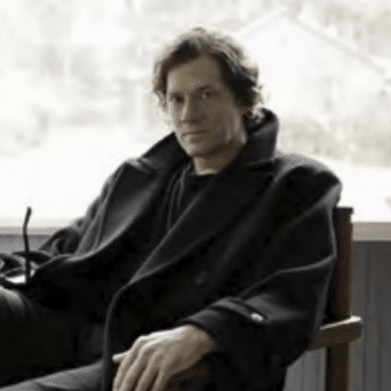 It was difficult for me. First, I never studied the form of musical theatre. My brother was in a bunch of musicals, and I knew those through him, but I, myself, was not a musical theatre person. In fact, I was a jock. Second, I’m often the main artistic creator and decision-maker on my projects. I write and direct most of my work, and I generally control everything that I do. Usually when I’m conceiving a theatre piece, I’m thinking of the entire world of it, the entirety of the audience experience, not just the dialogue or the stage directions. So, I was not used to being one of five people making decisions. But in television, a writers’ room is a chorus of ideas, a conversation around a table, and if you have a good room, best idea wins. That’s what we figured out how to do for The Outsiders — that way of working as a creative unit of authorship, and Danya (director of The Outsiders) has been terrific at centering herself within that as an audience advocate.
The adaptation process was psychologically tricky at first. I read the novel when I was 15 years old. I was really drawn to it. I have a lot of reverence for S.E. Hinton, for the worlds that she created and how she affected young people. My first several novels that were published were edgy Young Adult (YA) novels. I love writing about teenagers. I always have. I had a difficult childhood that shaped who I am today, so I really related to the characters in The Outsiders, who came from broken homes, from the blue-collar world, not fully educated in some ways, but beautifully articulate in other ways. I felt like that was something I could relate to. The intimidating factor was, “Am I going to screw this up?” When I approached the material, I wanted to consider the adult experience of the story, because I knew they would be ticket buyers and we wanted to appeal to both adult and kids. So, I leaned into the more adult subject matter of the novel: the violence and intensity in the novel, the thoughts of suicide and lovelorn broken homes. These are very serious themes. There is an operatic finale in the book that ends in a double death. The stakes are high, and it was important to me to take the beautiful template that S.E. Hinton created in her teen book and flesh it out in a way that was complex and at times difficult.
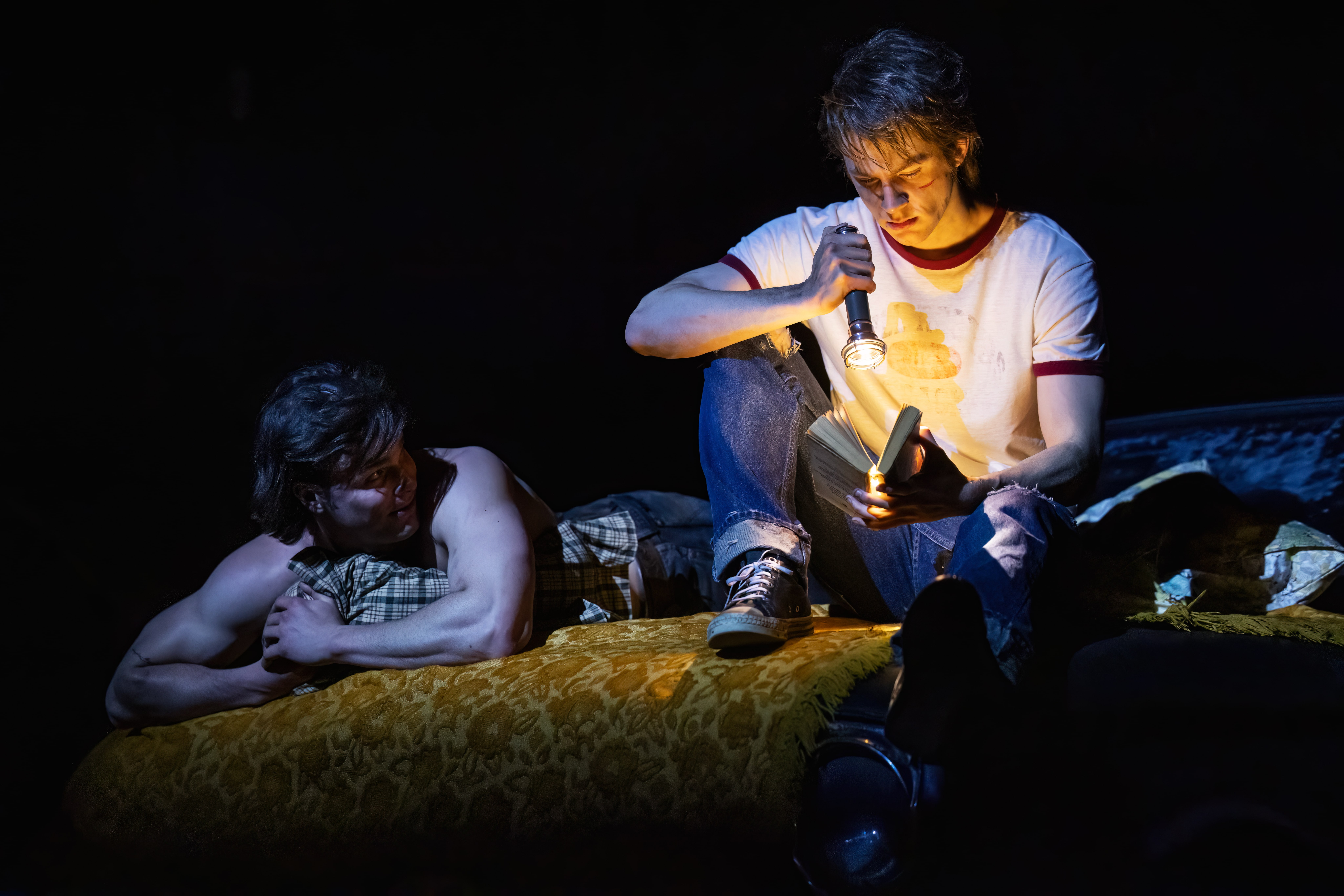
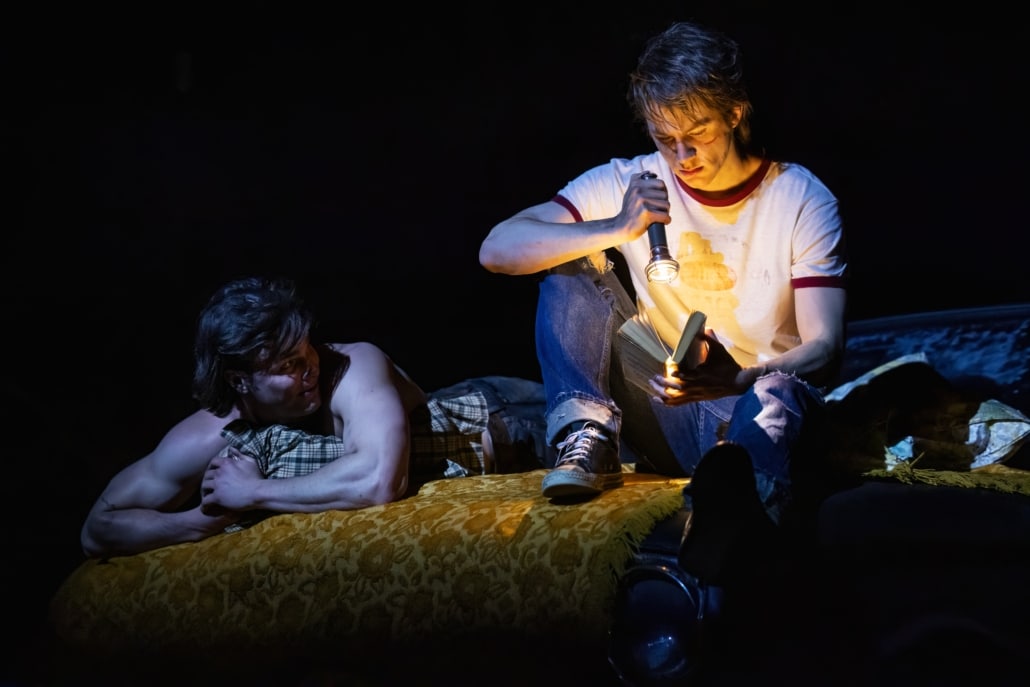
Jason Schmidt & Brody Grant. Photo by © 2024, Matthew Murphy
The notion of “am I going to make it in the world?” hits all of us at some at some age — 12, 13, 14 — when we start to become sentient beingswho can evaluate our moral compass and figure out what we want from the world. Are we going to be good people? Are we going to be bad people? Those are enormous questions that hit all of us around puberty. There is this huge life ahead of us, and there is something so profound about trying to discover who you are and who you will become — which is Ponyboy’s central pursuit.
Ponyboy has grown up in a broken home, with grief all around him — I think a lot of us do— but there is something hopeful about his making a choice to find a way to belong in the world and his discovery of art and writing as a way to tell his story.
The idea of chosen family is also powerful. The Greasers are a chosen family. They lead with toughness but love — sometimes it’s tough love; they really care about each other and look out for each other. I think it a testament to lower class in America where you have to fend for yourself, but you also have to find who your family really is because sometimes we don’t come from families that are intact. It is something that I think Susie tells beautifully.
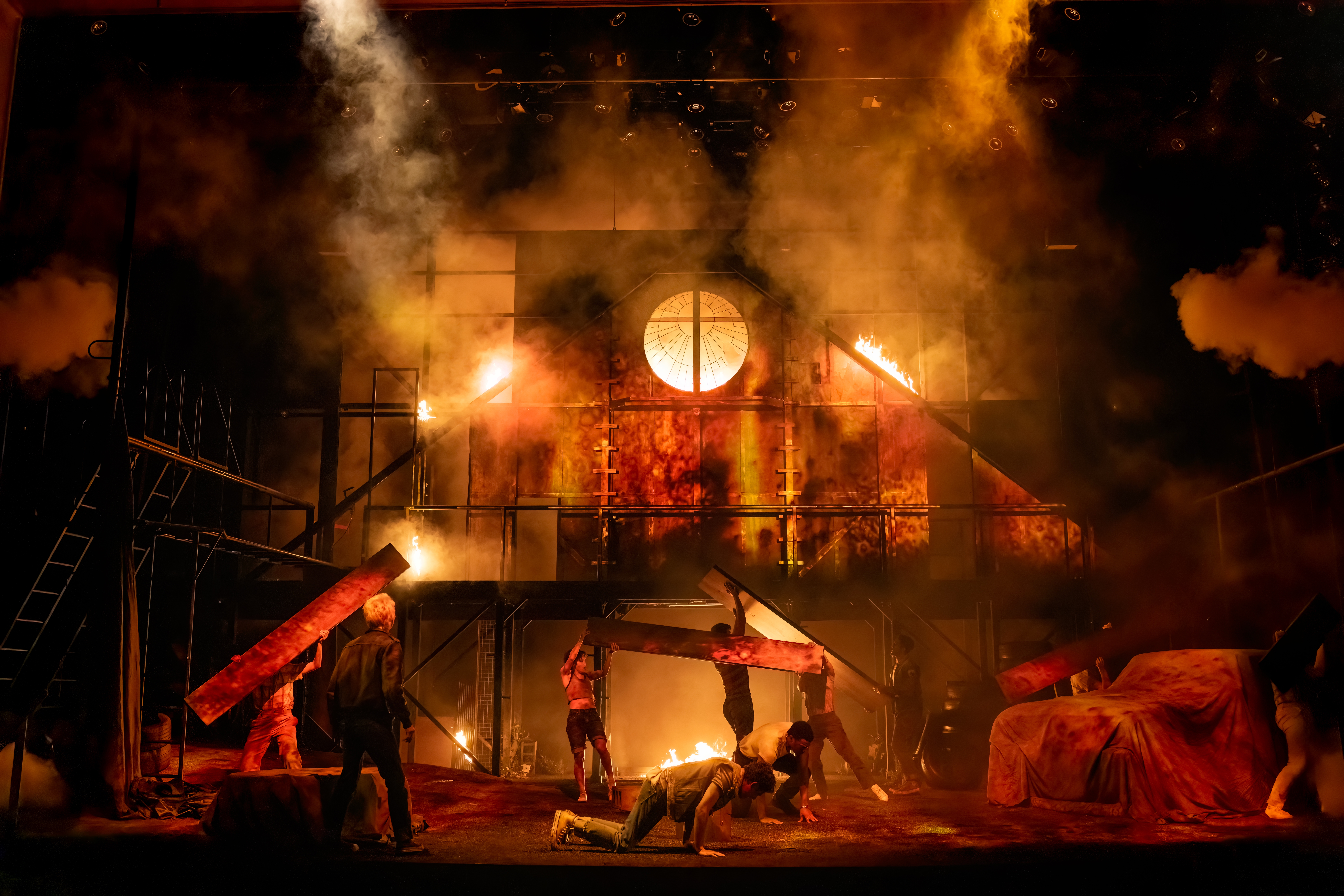
The Cast of The Outsiders. Photo by © 2024, Matthew Murphy
We did lot of research about Tulsa. There was the massacre of 1921 and then later the city was rebuilt to figure out how it was going to function socioeconomically, politically, racially. We didn’t want to color blind cast it. We knew the Socs would be white. That was a very accurate depiction we did research on. We asked Susie directly, if she intended for all the Greasers to be white. She did say that there were people of color in her community, but that she didn’t write about them explicitly because it didn’t occur to her to do so at that age. However, it could be compelling now. In the novel, she refers to Johnny as having a darker complexion. It didn’t feel like that was code for anything, but it did feel like it was a portal to look through to see if there was potential for diversity. It felt like it made sense in terms of the town where I grew up in Joliet, Illinois, which was a former steel town, a smaller version of Tulsa. I grew up in an apartment complex called Cedar Wood Apartments. We were one of very few white families. When Danya, Justin, Zach, Jon, and I started really discussing who the Greasers could be, we saw an opportunity to tell this story about America with a more defined look at race and at class because that is a huge part of America and especially in Tulsa.
Initially we weren’t sure who would be cast as Dally. In one of our early workshops before Broadway, the part of Dally was played by a terrific actor who was Black, and we saw the opportunity to lean into the racial element. We loved his relationship to Johnny, as a person of color, and we thought we could further create space for diversity with some of the Greasers. It worked, so we became attached to the idea of Dally being played by a Black man. He is the outlier of the group; he is from another part of the country. It all made sense to us in a way. We reached out to Susie and asked her how she felt about it, and she was completely behind it. I’m proud of the courage of the creative team to stand by this idea, but it did really require us to look at the end of the story.
It was debated back and forth. We really wanted to honor the book and the film and Susie’s vision of a guy taking on the system. In her novel, Dally baits a cop with an empty gun and it’s a powerful, urgent, and tragic life ending act for a boy who is struggling with grief and madness. We didn’t want to lose that, but we felt that if we had a character, who we cast as black, taking on the police, it would have tilted the musical into an event that’s so loaded that it would have created an imbalance in the musical. Suddenly, we would be talking about a young person of color who baits a cop into killing him, and not about Ponyboy’s story. And while I was not personally afraid of that conversation, in fact I think the theatre is always a great place to have a conversation when you are facing difficult matters, we felt like it was just too loaded right now, too triggering, and too traumatic. We discussed it with a lot of the creative team, especially after some of our designers of color brought it to our attention. Ultimately, we felt like the theme of the train, Ponyboy’s relationship to trains with his parents being killed by a train, would coalesce with Dally’s fleeing and reinventing his life by getting on freight trains (at least in our version of the story) could provide a way for him to take on the system without it being a cop. That felt like a way for us to have a very tragic and intentional suicide, without skewing the conversation into a current affair. Ultimately, we didn’t want to push the musical into a direction where that would be all that people would talk about when they left. We wanted people to talk about the holistic experience, Ponyboy’s journey, and this community of people.
I believe teens and preteens are so much smarter, more sophisticated, and more daring than we give them credit for. I think there are a lot of gatekeepers in the literary community and in our culture that are afraid of exposing kids to the truth of the world. I see it as honoring them. I believe that they can have really powerful reactions to these kinds of stories. They see the news and the internet with all kinds of horrors on it. They are seeing things in their own neighborhoods. It’s almost disrespectful to think that they can’t have conversations about these issues. I think it’s their right to be exposed to it and to have their own imagined world within it. And theatre is an excellent way to provoke those conversations.
This article originally appeared in The Outsiders study guide.
READ MORE
The Denver Center for the Performing Arts (DCPA) NewsCenter is the organization’s editorial platform for stories, announcements, interviews, and coverage of theatre and cultural programming in Colorado. We are committed to producing accurate, trustworthy, clearly sourced journalism that reflects our mission and serves our community.