DCPA NEWS CENTER
Enjoy the best stories and perspectives from the theatre world today.

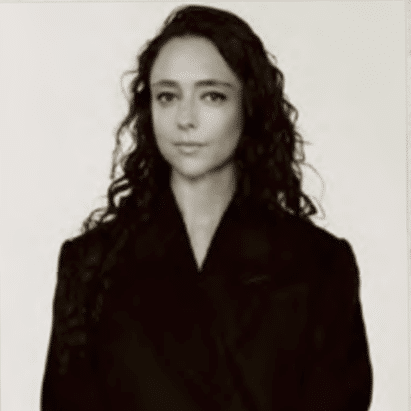 The development process for The Outsiders began about 8 years ago, but I didn’t join the team until 2021, when Adam Rapp, the book writer, saw a show that I directed on Broadway called Pass Over, that also examines the pressures our society puts on young men and the ways it limits their ability to express their fullness. Adam asked if I had any interest in directing a musical and I told him that it would depend on what it was. He told me about the project, about Jamestown Revival and Justin Levine who he had been collaborating with. And he told me it was based on a young adult novel called The Outsiders, and that the music moved him to tears every time he listened to it. That certainly got my attention. I had definitely heard of the book, but somehow, I had never read it. So, my first exposure to the story was through their incredible music and script.
Then I read S.E. Hinton’s breathtaking book, which I was completely stunned by. I started immersing myself with the writers, asking them a lot of questions, developing the script and score. We did a developmental lab in New York in the summer of 2022, where we had a chance to stage a stripped-down version of this show. Even though it was a bare-bones staging, the result of the lab was powerful, and we were able to perform it in front of an audience and experience their reactions. After the lab, we continued our work developing the script and then we took it to La Jolla Playhouse in San Diego, where we did an out-of-town production, which was invaluable. We were able to truly see what we had created and hone it throughout the preview process in front of live audiences. We learned what worked and what didn’t, and now we are taking that information and entering a movement and design workshop as well as a script and score workshop, getting ready for Broadway.
Yes! It’s amazing and unbelievable. I am so grateful for this opportunity.
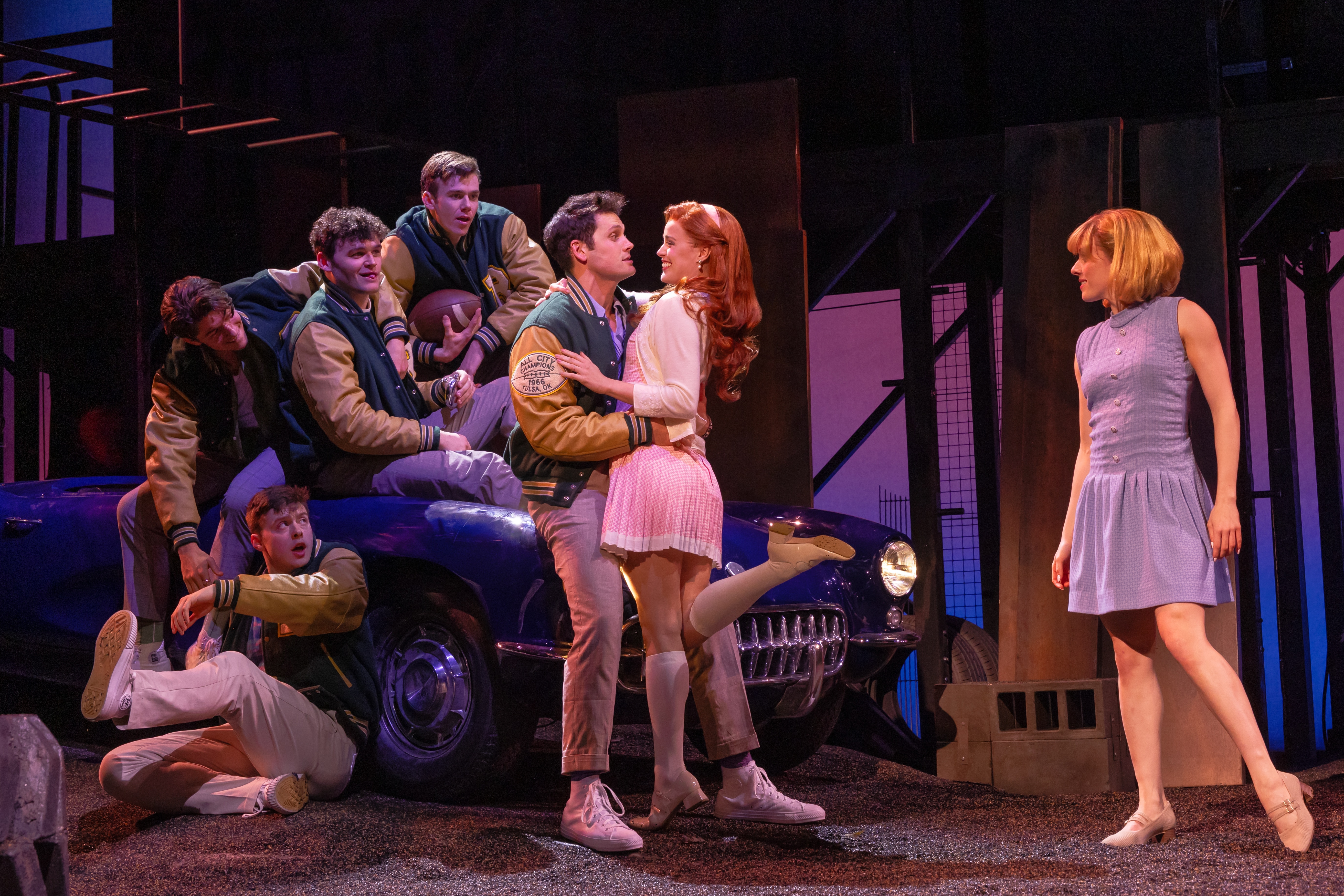
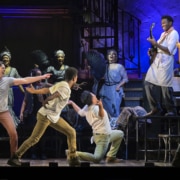
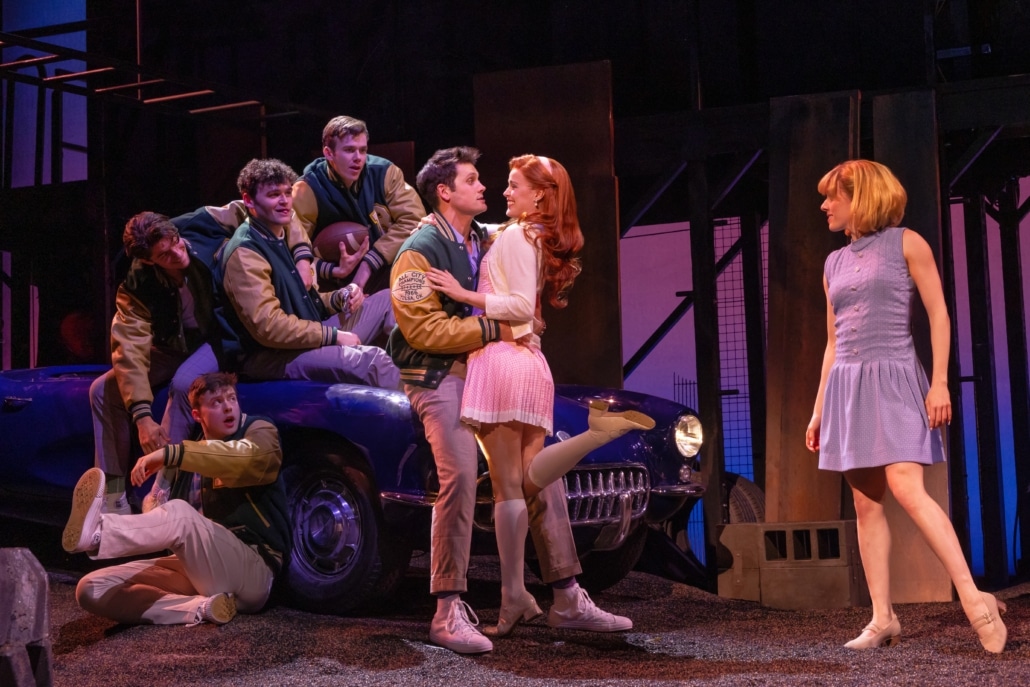
(Top) Barton Cowperthwaite, Dan Berry, RJ Higton, Kevin William Paul, Emma Pittman, Melody Rose; (Front) Sean Harrison Jones. Photo: © 2024, Matthew Murphy
The Outsiders is so powerful because it was written for teenagers by a teenager. Susie Hinton was 16 years old when she wrote the book, and she didn’t hold back on telling the truth, and people respond to her honesty. We were all teenagers at some point, and for many of us those were the most tumultuous years of our lives, full of visceral experiences that shape who we will become forever. The authenticity of Susie’s voice and the story she tells is why The Outsiders continues to resonate — it is a no-holds-barred account of what it feels like to be a teenager. Sure, the technology changes, what clothes are cool changes, but the feelings don’t change. I think that unadulterated voice is what makes The Outsiders so special and what we seek to bring to audiences in our adaptation.
The most exciting part to me is collaboration. That’s true with plays, but with a musical it’s a million times more. There are so many more people involved, so many more departments and modes of storytelling. You’ve got the music, book, choreography, scenic design, lights, projections, actors. The thrill of directing a musical is coordinating all these different departments and people to create one shared vision, one shared language, and I love that so much. Bringing out the best in people and harnessing the energy of a group towards a shared vision is what inspires me as a director. The most challenging part is the same as the most exciting part: It’s a lot of work! I also relish that; it is a privilege and an honor to do it, but it’s not for the faint of heart. There are a lot of moving pieces that all must be united to achieve something that ultimately feels effortless, inevitable, and undeniable.
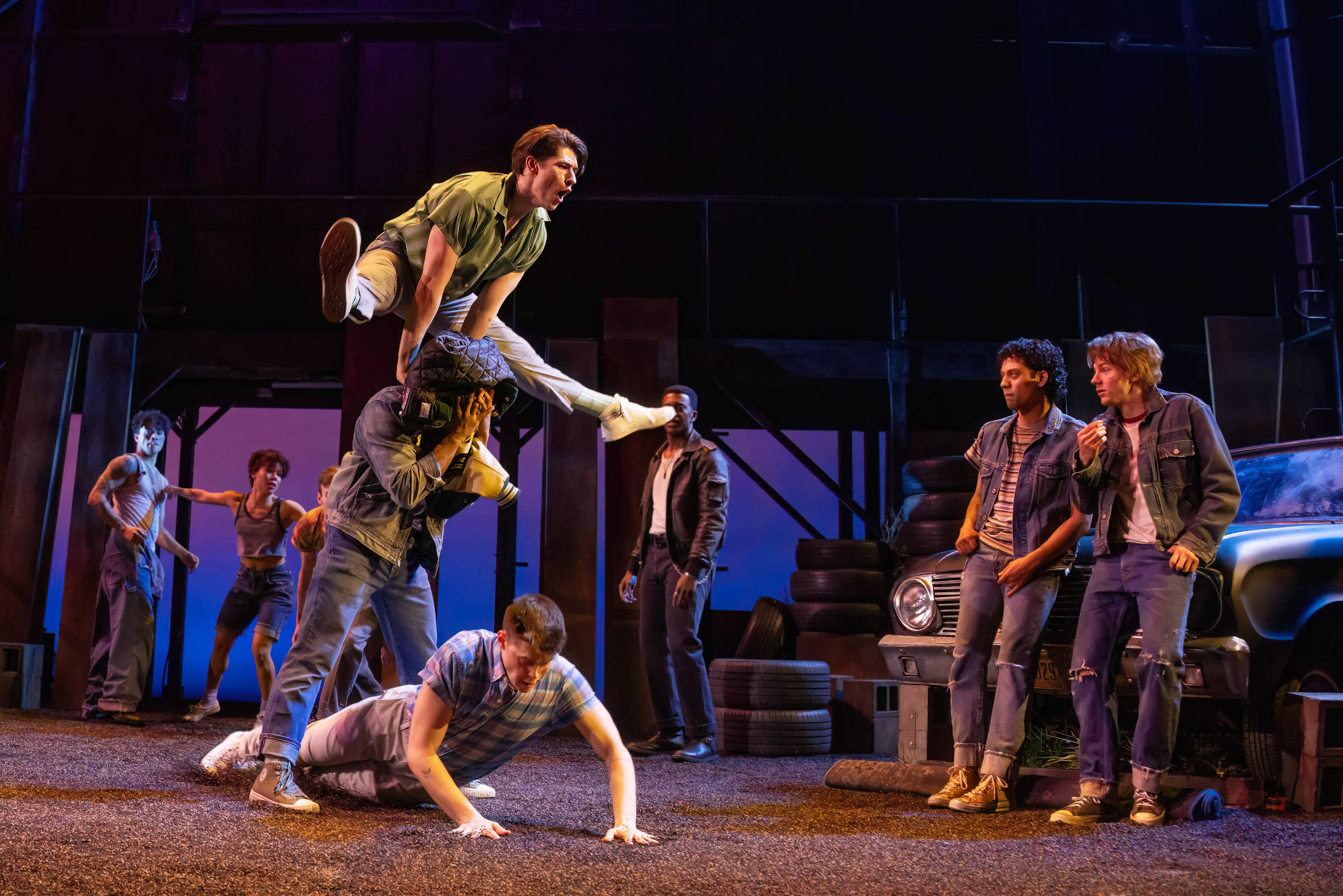
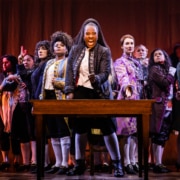
The Cast of The Outsiders. Photo by © 2024, Matthew Murphy
It’s such a good question. Playing around. Trying the scene in different ways. Asking questions. And I think through that exploration, hopefully the piece will tell you what it is, rather than the other way around. There have been times when we adjusted a performance or attacked a scene in a different way, we found what it was meant to be. There are other times when you realize that a scene can be cut or needs to change. There’s no magic answer. It’s really just about experimenting and not being afraid to try something in a totally different way. For instance, maybe a song is orchestrated for the piano, but if you change it to the guitar, it might crack something wide open. I think trying to be innovative and coming at it from a lot of different perspectives can reveal what needs to shift.
I didn’t always know I wanted to be a director, but I was exposed to theater at an early age. When I was about 6 years old, my mom took me to the children’s theater in my town and encouraged me to audition for the musical, which was The Wizard of Oz. I was cast as a Munchkin. I just loved the whole atmosphere. Later on, my high school theater teacher, Kristen Lo, introduced me to directing. She announced that the spring show would be a series of one-acts created by the students. She told us, “Everybody is going to write, direct, build the sets, stage manage, and act, and every job is as important as every other job. There is no one job that is better or more prestigious. They are all important.” And I think her love of theater and her belief that we could do anything was when I first started to feel that feeling of, “Ooh, I like directing. I feel more free doing this than I feel when I’m on stage.” She really championed that exploration for all of us, no matter which department we took an interest in, and her influence had such an impact on me.
Then I went to Duke, which is not known as a theater school, but which has some great theater professors and a lot of resources. I auditioned for the play my first year, and I remember when the cast list came back, I was listed as the assistant director. And I was like, “Huh?” I wanted to be in the play, but the director must have noticed something in me. I think if I had been at a more traditionally competitive theater school, I might not have had all the opportunities to try and fail that I did at Duke. While I was there, I also had the chance to work with a lot of people who had never ever been in a play before and certainly didn’t plan to be in the theater for their careers, and that in a way was the best training for me. You don’t necessarily need formal training to be a great actor, director, or theatermaker. Theater and storytelling are primal.
Ultimately, I think working in many different aspects of the theater makes you better at the thing you want to do. If you do want to be an actor, directing will give you a different appreciation of that craft. One of my first jobs out of school was working as the administrative assistant to an artistic director at a non-profit and it made me appreciate what all of the people who work in administration do, and how that is an art in and of itself.
Try it all, and also take in as much theater and art as you can so that you can understand what you like. Discover your own taste and sense of aesthetics. I think as a director, one of the skills that you need is to be able to receive a lot of different input and keep your true north, keep your spine, keep your vision. Let what wants to come in influence it, but also know that ultimately you can only make something that you think is good. And in terms of getting your foothold, I think stage management is a great way in. Early in my career, I had a residency at the Flea Theatre, and we had to stage manage for six months before we were allowed to direct, and it gave me an appreciation for rigor and how it all works. I think working backstage or front-of-house and all these other jobs can help you to become a director. Being around the thing you love, in whatever way you can, that’s the key.
It’s hard for me to want to dictate what anyone “should” feel. I just hope that the story might be able to unlock pent-up whatever that needs to find a way out. I think for different people that’s going to be different things. Some people might not know how to express tenderness or love and hopefully this will unleash those feelings and the ability to express those feelings. For others, it might be how to process through grief — what to do when you are feeling low, and you are having scary thoughts — how to get through something like that and get to the other side of it. How could I prescribe what anyone should feel? All I hope is that you feel and feel deeply.
This article originally appeared in The Outsiders study guide.
READ MORE
The Denver Center for the Performing Arts (DCPA) NewsCenter is the organization’s editorial platform for stories, announcements, interviews, and coverage of theatre and cultural programming in Colorado. We are committed to producing accurate, trustworthy, clearly sourced journalism that reflects our mission and serves our community.